
[UPDATE] Hiện tại Team đã nhận đủ hồ sơ và kết thúc thời hạn ứng tuyển. Cảm ơn mọi người đã quan tâm!
Huyền đang cần tìm 3 bạn hỗ trợ tạo script bài giảng cho các khóa học IELTS (script 100% bằng tiếng Anh), làm việc hoàn toàn online.
Deadline nhận CV: 18/12/2025
Mỗi bạn sẽ phụ trách 1 khóa.
- Khóa IELTS Listening (yêu cầu 8+ IELTS Listening)
- Khóa IELTS Reading (yêu cầu 8+ IELTS Reading)
- Khóa IELTS Speaking (yêu cầu 8+ IELTS Speaking)
Từng khóa đã có sẵn số Lesson.
Thu nhập: 300k/lesson (ví dụ khóa Listening sẽ có 15 Lessons)
Deadline: Hoàn thành khóa trong thời hạn 1 tháng (Listening), 1.5 tháng (Reading), 2 tháng (Speaking).
Những gì Huyền mong muốn:
- Bố cục rõ ràng từng phần để sao cho sau này team tạo slide presentation khi đọc vào lesson nào sẽ hình dung rõ ràng được nội dung và tạo slide một cách dễ dàng.
- Nói tới đâu có ví dụ thể hiện tới đó.
- Hãy luôn tưởng tượng bạn là beginner chập chững tự học IELTS → sẽ giúp bạn nhớ lại hành trình tự học của bản thân → giúp bạn “cảm” được để tạo bài giảng dể hiểu nhất.
- Ưu tiên các bạn đã có kinh nghiệm trong lĩnh vực biên soạn bài giảng, tài liệu IELTS
Cách thức đăng ký:
- Bạn gửi giúp Huyền CV kèm Porfolio và chứng chỉ IELTS qua tuvan@ielts-nguyenhuyen.com nhé.
- Nếu bạn đăng ký Listening: tiêu đề email CV ĐĂNG KÝ SCRIPT KHÓA LISTENING
- Nếu bạn đăng ký Reading: tiêu đề email CV ĐĂNG KÝ SCRIPT KHÓA READING
- Nếu bạn đăng ký Speaking: tiêu đề email CV ĐĂNG KÝ SCRIPT KHÓA SPEAKING
- Nếu chưa có Porfolio bạn có thể làm thử một phần bài giảng theo hướng dẫn sau (bài giảng 100% tiếng Anh):
- Nếu bạn đăng ký script khóa Listening: Bạn hãy tạo một phần bài giảng cho Lesson 12: How to answer Map Labelling Questions
- Nếu bạn đăng ký script khóa Reading: Bạn hãy tạo một phần bài giảng cho Lesson 16. How to answer Matching headings Questions
- Nếu bạn đăng ký script khóa Speaking: Bạn hãy tạo một phần bài giảng cho Lesson 14. Describe a place (IELTS Speaking Part 2)
Đây là một đoạn bài giảng mẫu trong Lesson 5 của khóa IELTS Writing Task 1
Alright everyone, today we’re moving on to Lesson 5: How to write an overview for IELTS Writing Task 1.
So first of all, what exactly is an overview? Well, it’s simply a summary of the main or most important points in a chart, process, or map.
Now, where do we put it? You can put it after your introduction. So the basic structure looks like this:
Introduction then Overview then 2 Body Paragraphs.
So, how do we actually write an overview?
It really depends on the type of Task 1 question you’re facing. In this course, we’ll learn how to write overviews for four key types: dynamic chart, static chart, proces, and map.
First, dynamic chart.
1. If it’s a dynamic chart (something changing over time):
What are dynamic charts?
Well, dynamic charts are charts that show change over time. They show you how things increase, decrease, fluctuated or remain the same over a certain period.
So whenever you see a time axis — like 2000, 2005, 2010 at the bottom of the chart — that’s your signal: this is a dynamic chart.
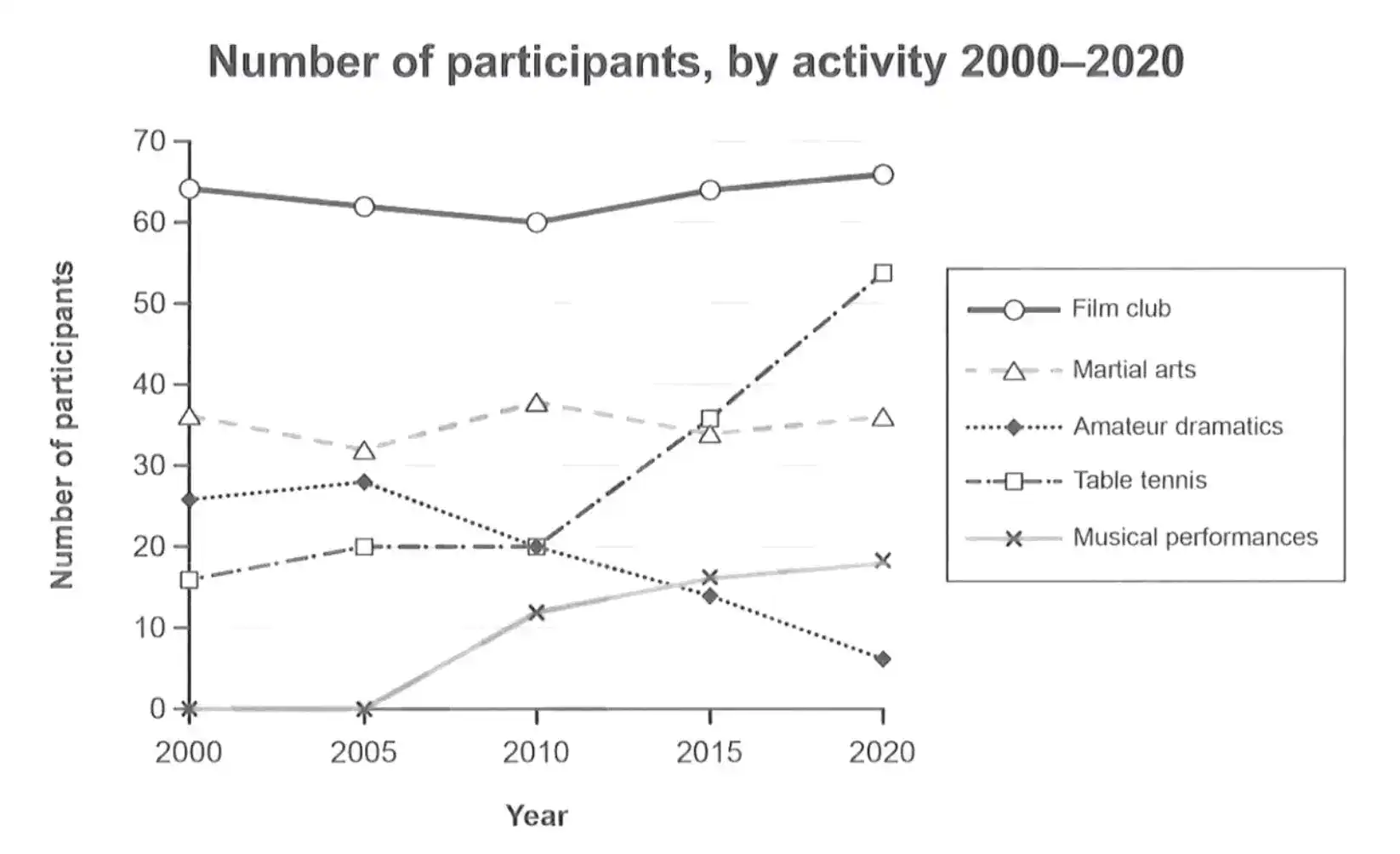
If it’s a dynamic chart, to write a good overview, ask yourself 2 questions:
👉 Question 1: Do the figures generally go up, go down, fluctuate or remain stable over time?
👉 Question 2: Among all the categories, which category is the highest and which one is the lowest?
Now let’s practise with this graph. It shows the number of participants in different activities at a social centre in Melbourne from 2000 to 2020.
You’ve already analysed this graph with me in the previous lesson, so I’m not going to go through every line again. Instead, let’s jump straight into the overview.
Remember our two questions?
- What’s the general trend?
- And among all the categories, which one is the highest and which one is the lowest?
Okay, let’s tackle Question 1: What’s the general trend?
Well, if we look at amateur dramatics, we can see it clearly went down over the years.
Then, table tennis and musical performances — both of these went up.
And martial arts? That one pretty much stayed stable, with only small changes here and there.
So overall, we’ve got one activity declining, two activities increasing, and one that stayed the same.
Alright, now let’s move on to Question 2: Among all the categories, which one is the highest and which one is the lowest?
If we look across the whole period, film club is always at the top. So, the big picture is very clear: film club remained the most popular.
Alright, so we’ve answered two questions. Now let’s put everything together, and we’ll have an overview like this:
‘Overall, film club consistently attracted the highest number of participants throughout the period. While amateur dramatics declined markedly, table tennis and musical performances recorded the most significant growth, whereas martial arts figures remained relatively stable.
And that’s it — a complete overview in just two sentences, covering the key trends, and the highest and lowest.
So, that’s how we write an overview for a dynamic chart — the type that shows changes over time. Pretty simple, right? Just focus on the overall trends, and identify the highest and lowest.
Now, we’re going to move on to the next type: the static chart.